Work in progress
The Derivative Function
Why Do We Use the Derivative Function?
The derivative function allows us to determine the monotonicity of the original function. In other words, it tells us how the values of the original function (the function from which we calculated the derivative) change. A derivative also allows us to determine the points at which the original function has an extremum, meaning either its maximum or minimum value. An extremum can be local or global. For example, consider the polynomial: .

Looking at the graph, we can see that point A1 is a local extremum, more specifically a local minimum. This is because if we move a small distance to the left or to the right of point A1, the value of the function at A1 is lower than the values at the nearby points. However, A1 is not the global minimum. If we look at point A2, we can see that the polynomial reaches its lowest value there. Therefore, A2 is the global extremum, more precisely the global minimum. It is also worth noting that A2 is a local minimum as well.
How Do We Find the Detrivative Function?
You could say that we simply use ready-made formulas. Depending on whether our function consists of basic elementary functions or is a composition of several different functions, we apply the appropriate rules. When it comes to basic elementary functions, we use the following standard formulas:
Where Do These Formulas Come From?
To answer this question, let’s take a look at the geometric interpretation of the derivative.
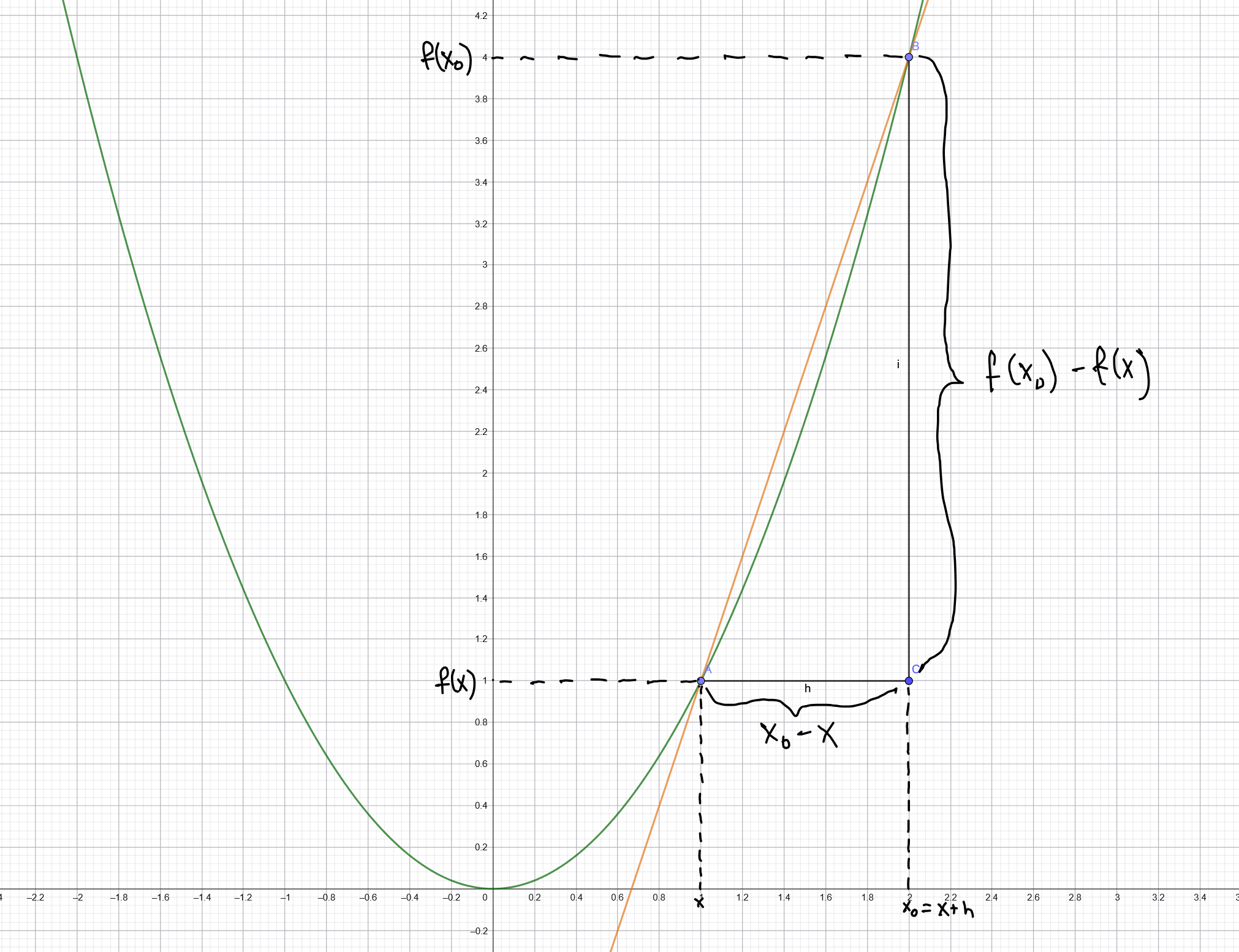
Geometrically, a derivative represents the slope of a tangent line to a curve at a given point. If we take two separate points on a graph, the fraction below calculates the slope of the line passing through them (called a secant line). By applying a limit, we bring these two points infinitely close to each other. As the distance between them shrinks to zero, the secant line transforms into a tangent line. This process can be expressed using one of the following two equivalent definitions:
, but we will use the first one for easier calculations.
Both definitions yield the exact same result. As an example, let’s calculate the derivative of the function using the limit definition. Substituting it into our formula, we get:
Now, we can generalize this method for the power function . Using the algebraic identity for the difference of -th powers, we can expand the limit as follows:
Evaluating the limit by substituting , each term in the expression transforms:
Why do we end up with exactly identical terms of ? If we closely examine the expression inside the limit, we can track the powers of across the sequence. In the first term, we implicitly have (giving us ), in the second term we have , and this pattern continues all the way up to the final term . This forms a sequence of exactly elements. At this point, we have obtained the expression in terms of rather than . Since was chosen as any arbitrary point, we can replace it with a general variable , which gives us the final derivative formula: .
Following this exact principle, we can mathematically prove every single formula from our table—though some functions might require a few clever algebraic tricks along the way.